
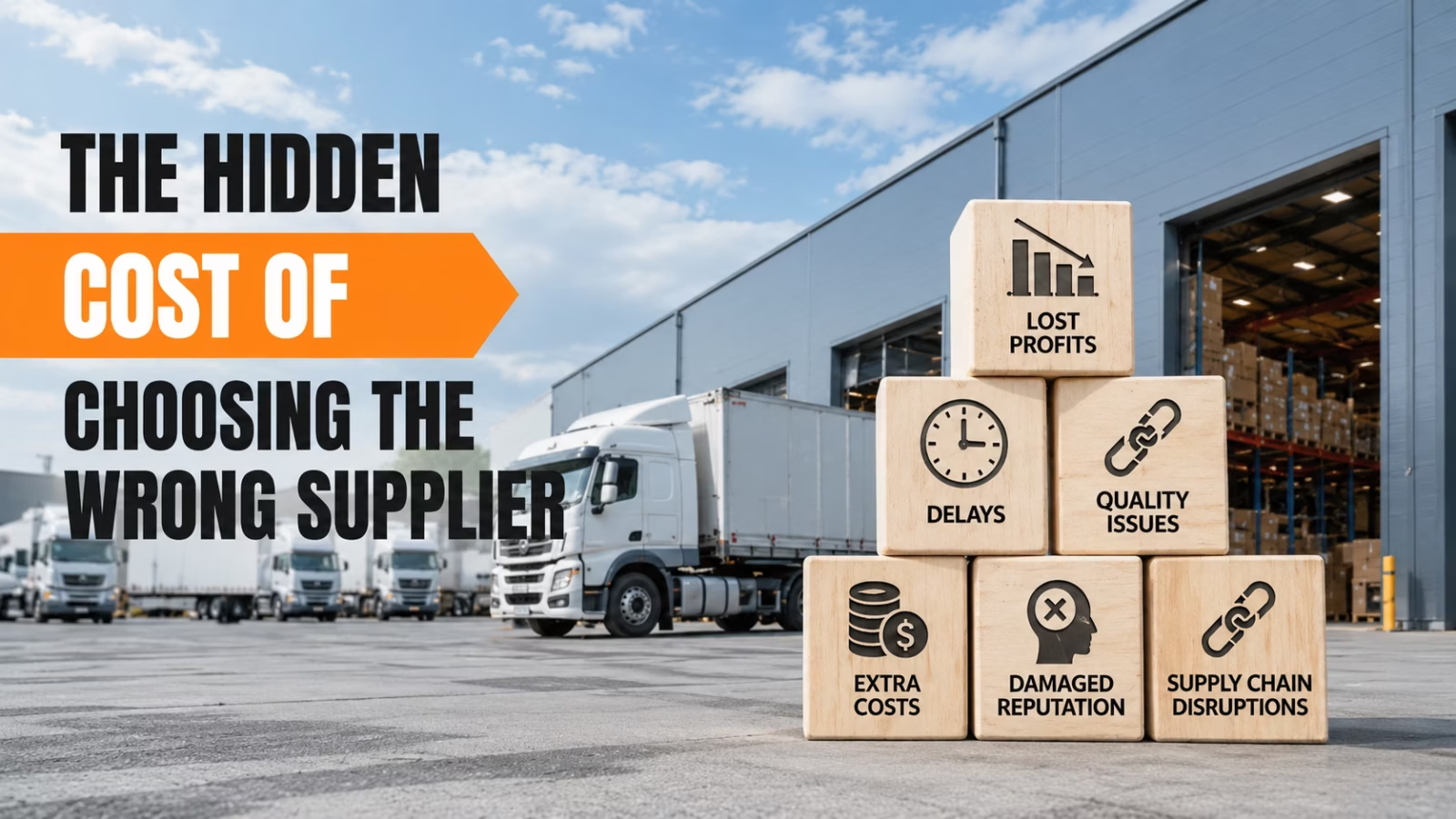
The Hidden Cost of Choosing the Wrong Supplier
Every sourcing decision starts with a number. A unit price, a percentage discount, a line on a comparison sheet that looks better than the others. It’s the easiest thing to measure — and, in FMCG distribution, often the least reliable indicator of what a supplier relationship will actually cost.
We’ve watched this pattern repeat across hundreds of shipments and dozens of markets: a company chases a 4% lower unit price on paper, then spends the next two quarters absorbing a fallout worth three or four times that saving — expedited freight to cover a missed production window, penalty clauses triggered by late delivery, emergency sourcing to fill a gap that shouldn’t have existed, and a retail partner who quietly starts giving shelf space to someone more predictable.
The cheapest quote and the lowest total cost are almost never the same number. And the gap between them is exactly where most importers get burned.
Why Price Comparisons Miss the Real Risk
A quote tells you what a supplier charges under ideal conditions. It says nothing about what happens when conditions aren’t ideal — and in international trade, they rarely stay ideal for long. Port congestion, currency shifts, raw material shortages, a customs officer who flags one incomplete form: these are not edge cases. They’re the normal operating environment.
The suppliers who look identical on a price sheet often behave very differently the moment something goes wrong. One absorbs the disruption and keeps the shipment moving. The other passes the cost, the delay, and the blame straight down the chain to the distributor who chose them.
The Questions That Actually Predict Reliability
Distributors who scale sustainably tend to ask a different set of questions before signing — not “what’s your best price,” but:
• What’s your on-time fill rate, measured over the last 12 months, not the last successful shipment?
• How do you handle a documentation error at customs? Do they catch it before the container ships, or do they wait for the distributor to discover it at the border?
• What happens when demand spikes 30% in a month? Is there spare production capacity, or does every order compete for the same limited slot?
These questions are harder to ask in a first meeting, and harder to answer honestly if the supplier doesn’t have a good track record. That’s exactly why they’re more useful than any price comparison.
Reliability Is Invisible — Until It Isn’t
The uncomfortable truth about supplier reliability is that it produces no evidence when it’s working. A shipment that arrives on time, correctly documented, at the agreed price, doesn’t generate a story. Nobody writes a case study about the container that showed up exactly when it was supposed to.
Reliability only becomes visible in its absence — in the missed retail deadline, the emergency air freight bill, the buyer who stops returning calls. By the time the cost is visible, it’s already been paid.
This is why total cost of ownership, not unit price, has to be the starting point for any serious supplier evaluation. Freight, customs handling, documentation accuracy, communication speed, and demand flexibility all belong in that calculation — because they all show up on the invoice eventually, just not the one you were expecting.
The Takeaway for Procurement Teams
A 4% price advantage is real money, and no distributor should ignore it. But it’s only an advantage if everything else holds — and in cross-border FMCG sourcing, everything else rarely holds without a supplier who’s built for it.
The distributors who protect their margins over the long run aren’t the ones who win every price negotiation. They’re the ones who correctly price the risk they’re not seeing on the quote.
Copyright ValexTeam © 2020. All Rights Reserved | Privacy Policy